What is Free Chlorine? What is Total chlorine?
18 November, 20191. Why is chlorine the most widely used in water treatment?
Chlorine and its compounds are the most produced and consumed chemicals in the world for a variety of purposes such as disinfectant, white pipes, detergents, etc. Hundreds of years ago, chlorine was used as a water treatment agent. With the advantage of high disinfection efficiency, low cost and less danger to users, chlorine disinfection is by far the most widely used method to treat feedwater, pool water, and water waste.
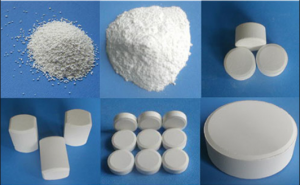

Figure 1: Chlorine powder and tablet form for water treatment
2. What is Free Chlorine? What is Total chlorine?
Chlorine is added to normal water in the form of pure chlorine Cl2 or chlorine compounds such as sodium hypochlorite (NaClO), calcium hypochlorite (Ca (OCl) 2). Cl2 will quickly react with water to form the products as shown below:
Cl2 + H2O → HOCl + H + + Cl-
Hypochlorite salt also reacts with water to produce a product with HOCl:
Ca (OCl) 2 + 2H2O → Ca2 + + 2HOCl + 2OH-NaOCl + H2O → Na + + HOCl + OH-
HOCl is a weak acid, so it dissociates in water according to the equation:
HOCl ⇔ H + + OCl-
HOCl is a more powerful disinfectant that can kill bacteria in seconds, while HClO- can take up to 30 minutes. At pH <7.5, HClO predominates, whereas at pH> 7.5, ClO- dominates in solution.
Chlorine reacts with many substances present in water such as metals, nitrogen-containing compounds (ammonia (NH3), nitrogen-containing organic substances (amino acids, …)).
Chlorine reacts with ammonia to form many products:
NH3 + HOCl → NH2Cl (monochloramine) + H2O
NH2Cl + HOCl → NHCl2 (dichloramine) + H2O
NHCl2 + HOCl → NCl3 (trichloramine) + H2O
Chlorine reacts with organic substances to form organic chloramine.
Organic monochloramine, dichloramine, trichloramine and chloramine are called chlorinated bonds.
Cl2, HClO, ClO- has not reacted with any substance in the water called residual chlorine or free chlorine.
Total chlorine = Residual chlorine + Bonded chlorine.The presence of residual chlorine in water proves that the disease-causing microorganisms in the water have been killed.